


Identity Construction and Play
Identity Construction and Play
It is emphasized that play has been an important element not only for kids but also for adults throughout history. Play is a phenomenon that accompanies humans throughout their lives and, with its varying structures across cultures, plays a critical role in individual development and social integration. Especially in education, it is evident that play and the learning process cannot be considered separately. Educational institutions help individuals gain a social identity while also strengthening their social interaction skills. School is a crucial institution contributing to individual character development, and play is one of the most effective tools supporting this process.
Play, Identity, and the Preservation of Cultural Values
Identity is shaped both individually and collectively. Play has a significant impact on the transmission of cultural heritage and the preservation of values. Traditional games help kids reconstruct their social identities in the face of individualization and technological isolation brought about by modern times. Rahmawati & Harsono (2018) emphasize that traditional games support kids' character development and strengthen their connection to societal values. Play helps kids discover their individual boundaries while also providing an environment that enhances their social adaptation and cooperation skills.
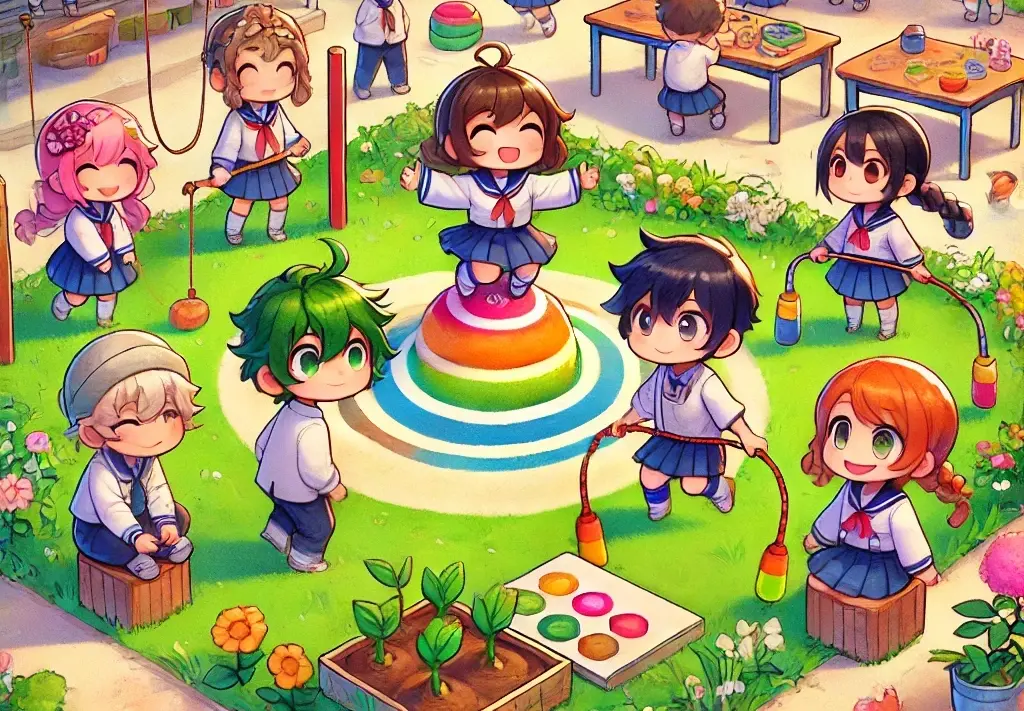
Play and Environmental Education
Kids develop not only their physical and cognitive skills while playing but also gain awareness of their environment. Environmental education can be integrated with play to help kids grow into environmentally conscious individuals. For instance, through nature-themed games, kids can better understand ecosystems and learn about sustainability by experiencing it firsthand. Environmental awareness can be instilled directly through play, helping them become more responsible individuals in the future.
Play, Social, and Cognitive Development
Kids' games, with their rhymes, rules, and the imaginary worlds they open up, allow kids to escape the pressures of the real world and express themselves freely. Play becomes a tool for them to discover their potential. Johnson, Yawkey, and Christie (1987) state that kids learn on two fundamental levels during play:
On the first level, they learn the meanings of objects and situations in the game as they relate to real-life counterparts.
On the second level, kids discover both their own identities and those of other players in the context of real-life meanings.
This process helps individuals enhance their social interactions and strengthen their sense of empathy. Kids share their ideas with one another during play, creating a shared culture and social environment. In this way, they reinforce both their individual identities and their sense of friendship and solidarity.
In conclusion, play is not only a means of entertainment but also a crucial educational tool for the transmission of cultural heritage, identity development, and environmental awareness. Incorporating games into the educational process makes learning more effective and enjoyable for kids while also helping them grow into more conscious and socially engaged individuals.
 Previous